
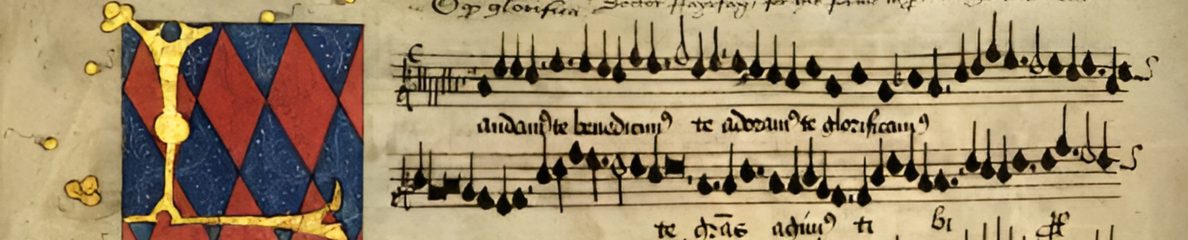

Juan Esquivel: A Master of Sacred Music during the Spanish Golden Age
by Clive Walkley
Review by Roger Wilkes
Clive Walkley, Juan Esquivel: A Master of Sacred Music during the Spanish Golden Age, The Boydell Press, 2010. ISBN 9781843835875. 270pp. £55.
Clive Walkley’s workshops, devoted to various aspects of Spanish sacred music during the Renaissance period, have for some years now been a familiar, greatly appreciated, ingredient within the programme of both NWEMF and, increasingly, other early music fora. Many, attending the NWEMF Summer School, have been enlightened and enthused by their encounters with this glorious repertory, under Clive’s expert guidance. Some readers who read this review will be looking forward to 9 April when Clive Walkley’s latest workshop will take place in Natland, near Kendal – a workshop being devoted to representative pieces by this wonderful Spanish church musician from the late 16th and early 17th centuries.
It has long been a source of frustration, to this reviewer at least, that examinations of Spanish sacred music from the Renaissance period have been so difficult, indeed near-impossible, to come by. Robert Stevenson’s landmark appraisal of Spanish Cathedral Music in the Golden Age is now exactly half a century old. No ‘mainstream’ publication devoted to this repertory has subsequently appeared; so, for our knowledge of the subject, we must largely rely on specialist articles published in (mainly scholarly) journals or as part of expensive anthologies. General histories of music, even those devoted to the Renaissance, scarcely embrace the subject beyond their statutory acknowledgements of the sublime achievements of Victoria and, if one is lucky, Morales; figures such as Esquivel, Alonso Lobo, Vivanco, even Guerrero, frequently escape without any mention. This sad fact is all the more reason to welcome this very timely book – the more so because it happens to be an excellent one.
Neither the (already long) title nor, in particular, the summary of the book’s contents on the back cover do full justice to the scope of this compendious and comprehensive publication, the contents of which venture far beyond what we could dare hope for. It is, of course, right to place Esquivel, his career and compositions, at the heart of this book. Scant documentary information about Esquivel’s life survives, yet we gain as clear as possible (and, incidentally, as engaging) an impression of his career as Clive’s survey, aided by his citation of various primary sources, permits.
Esquivel – still sparsely represented by modern performing editions of his music (despite the valiant efforts of Clive, Bruno Turner, and others at Mapa Mundi) – was in his lifetime unusual among his compatriots in seeing his works published. Three large volumes of sacred polyphony appeared in 1608 and 1613, and the contents of each of these collections are examined here in some detail. The author’s obvious enthusiasm for his subject does not cloud his judgement; the true quality of each work considered, whether fine or indifferent, is assessed with due objectivity.
Impressive as these ‘life and works’ chapters are, arguably what the reader will find even more valuable in this book are its other contents. Anyone whose interest ventures beyond a gentle sing-through, or play-through, of selected compositions must have posed many questions, the answers to which help ‘explain’ the career and music of men like Esquivel. Was Esquivel’s career as a Spanish cathedral musician typical, both for other Spaniards and for other European Catholic musicians and composers, during this period? How, and to what extent, was Spanish sacred music affected by the pronouncements of the Council of Trent in the mid-sixteenth century? What was the so-called Counter-Reformation, and how was this construed by Spanish churchmen during Esquivel’s lifetime? Which people and what factors, musical and otherwise, helped to determine Esquivel’s musical style and technique? What were the various criteria for composition of Spanish sacred music composition during the late Renaissance period? How were church musicians like Esquivel engaged, and what were their working conditions like? Were Esquivel’s works subject to any professional scrutiny, and, if so, how? The answers to these and very many other germane questions are supplied in this extremely thorough account.
The book features the customary paraphernalia of a sound scholarly publication: an extensive and wide-ranging bibliography, abundant references (here conveniently placed as footnotes rather than being relegated to back pages), a well laid-out index, and citation of many primary sources. Musical examples are numerous and often extended, especially given (as the author acknowledges) the current paucity of performing editions of Esquivel’s music.
Almost inevitably for a publication of this size, errors have crept into both the typescript and the musical examples – though these, being relatively few and generally self-evident, are no more than a minor inconvenience. This book, in sum, will help to fill a huge void in our understanding and appreciation of Spanish sacred music from the late Renaissance period. As I have already indicated, the book’s scholarly credentials are impeccable – yet the author’s lucid, very approachable style will make it readily accessible, and appealing, to the non-specialist reader. Publications such as this don’t come cheap, but this one is certainly worth every penny
Roger Wilkes
Published in April 2011 Newsletter
