

Chant Workshop: Holy Cross Day
VOICES
Tutor: Philip Duffy
Location: St Nicholas Church, Pier Head, Liverpool
Reviewer: Morris Davies
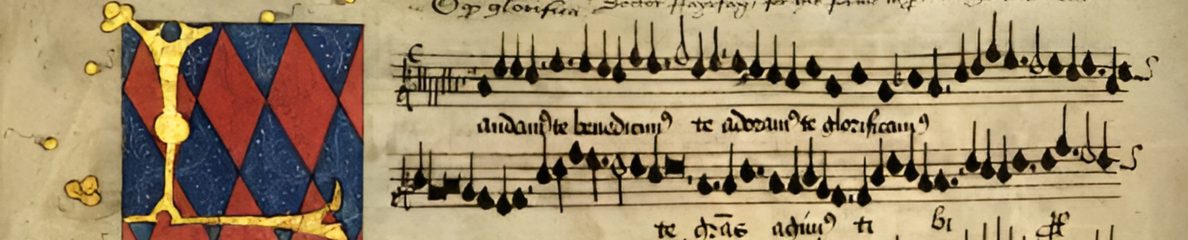
Some 18 of us met for a Chant Workshop in Liverpool Parish Church, about half with high voices facing the lower voiced. The following day was to be the Feast of the Exaltation of the Holy Cross and Philip had chosen chant for First Vespers for the day. The basic simplicity of chant notation is complicated by a quantity of technical detail which Philip explained. A note of unit length (a quaver) can be notated as a square, a square with tail, a lozenge. Sing the lower then the upper of two notes aligned vertically; a note followed by a lower one is sometimes joined to it by a broad conspicuous stroke. One way to lengthen a note is to place after it a quilisma – shaky strokes of a broad ended quill – in the space between two of the four-line stave – clear enough on ancient parchment with 12 mm between lines but no longer so in the 2mm spacing of modern copies. A small cedilla-like sign appended to some note indicates a note of that pitch and of standard length but indicates too a change to the pronunciation of its syllable.
Whatever hindrances this may place before the novice reader, they pale into total insignificance compared with various notations (known as neums, squiggles written above the text) that may have accompanied texts at the time when many chants were being composed – from the 7th century onward. In the handout Philip included the chant for the Good Friday Reproaches starting Popule meus, quid feci tibi? in its usual notation, together with the neumed version from Leon (after 930) and Einsiedeln (beginning of 11th century), very unlike each other, neither remotely like their present form. He later circulated a series of 16 versions for another text that have appeared down the ages.
The workshop was a preparation of the chant – splendidly illustrated by Philip – for Vespers with its customary Hymn, Psalms and the Magnificat with their antiphons, New Testament readings, Prayers, and ending with Salve Regina. Psalms, readings and prayers consist in recitation on one note with initial and cadential formulae, with more variety in the antiphons.
The beautiful Salve is relatively well known but much less so was the Hymn, Vexilla regis prodeunt, a fine tune, and special to this particular occasion. It is one of the greatest hymns of the liturgy and is also one of the very few from early times for whose origin we have exact information. Its author was Venantius Fortunatus (530-609), who wrote it in honour of the arrival of a large relic of the True Cross which had been sent to Queen Radegunda by Justin II, Byzantine Emperor from 565 to 574. Radegunda, Queen of the Franks, had retired to a convent she had had built near Poitiers and was seeking out relics for the church there. To help celebrate the coming of the relic, the Queen asked Fortunatus to write a hymn to greet its arrival at the church and the hymn was first sung in the procession on 19 November 569. Thus the hymn has a strong connection with the Cross. (Palestrina set it.)
The performance of Vespers itself was an occasion of quiet dignity and we were grateful to Philip for having made it possible.
Morris Davies
First published in September 2014 Newsletter
