
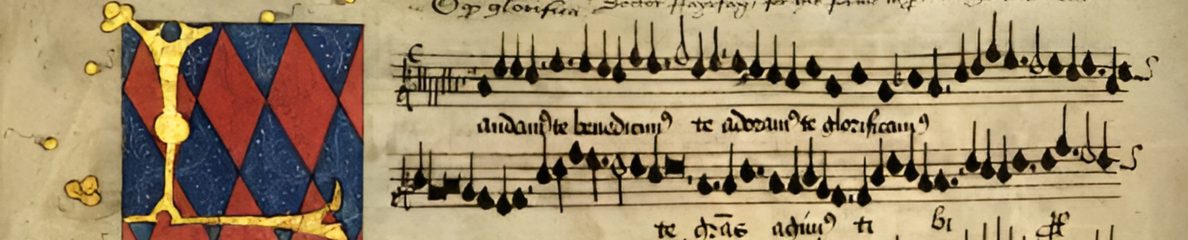

Greatest Glory of our Muses: Church music of Robert White (c1538-1574)
VOICES
Tutor: Peter Syrus
Location: Church of the Holy Ascension in Upton-by-Chester
Reviewer: Valerie Pedlar
I’m a relative newcomer to the workshops run by NWEMF and must say how much I’ve enjoyed the workshops I’ve attended in the past two years. I’m also intensely grateful for the introduction they provide to music that I probably wouldn’t otherwise encounter.
Last Saturday (21 June) a good-sized group of singers (more tenors than basses!) gathered in the Church of the Holy Ascension in Upton-by-Chester for a workshop led by Peter Syrus on the church music of Robert White, a composer who is known above all for his Lamentations. Peter helpfully provided us with scholarly notes that gave biographical details, a list of known compositions (vocal and instrumental) and a select bibliography. Further research that I’ve done on the internet indicates the paucity of recordings of anything other than the Lamentations (and of the 2 sets he wrote, it seems to be the set for 5 voices that is most often performed), though I’ve spotted some motets on YouTube.
Peter’s workshop introduced us to three Psalm settings and versions of the Compline hymn, Christe, qui lux es et dies. We started with the chant version of the hymn, as a warm-up and to practise our English church Latin, then moved on to sing 3 of the 4 settings that White made of this hymn. This was fascinating. In each setting the odd numbered verses were sung to the original chant, whether by high or low voices, but the settings of the even numbered verses were very different. The first version, for instance, was almost all in minims and nearly totally homorhythmic with the chant in the top line for verses 2 and 6 and in the third line (marked ‘contratenor’) for verse 4. We learned that this version was a ‘falsibordoni’, a term I hadn’t encountered before. I imagine that it’s what I’ve previously known as fauxbourdon, and have only half understood! In the fourth version, on the other hand, the set verses were polyphonic with some athletic intervals and rhythms that made for more challenging sight-singing.
The Psalm settings gave us further insight into White’s techniques. The Dominus, quis habitabit was the second of three settings White composed to those words and has, as Peter said, an architectural structure, with careful deployment of the six voices. And here I encountered another new word – ‘Gimel’ – which I had previously known as a letter of the Hebrew alphabet. Having checked the definition (the division of a part – usually a higher part – into two which frequently sing in parallel thirds) I realise how the technique had been developed in White’s music. In the Gimel of Dominus, the second and fourth lines divided and the part writing was imitative rather than simply parallel. In Justus es, domine, another of the Psalm-settings, the Gimel was indeed for divided upper voices (first and second lines), but included a bass part too, and again made great use of imitation. This is something that can be very helpful when you’re sight singing – if you spot it in time!
The major work for the day was White’s Miserere mei, Deus, a heartfelt setting of those well-known words of spiritual self-flagellation associated with Easter. Here we had the subtle interplay between block harmony and polyphony that is characteristic of much Renaissance music, the ‘false relations’ that are such a feature of English music at that time, and, crucially, a frequent setting of one part against the other four, which allows the words to be heard more clearly. This was a long piece and if our final ‘performance’ was far from perfect, it was very satisfying to have the experience of singing through a masterpiece of Renaissance music.
The workshop took place in a church that was comfortable and well equipped rather than acoustically exciting. This is one area where you certainly can’t have everything! White’s music would have been more gratifying in the more generous acoustic of a bare church, but creature comforts become important when you’re there for a full day’s singing. In any case, it was a wonderful opportunity to explore this music and to learn more about a composer who was considered by one sixteenth-century writer to be one of the principal musicians of his generation.
Valerie Pedlar
First published in June 2014 Newsletter
