

Photo by Modern Mooch
“Gaudeamus!” borrowings in Spanish church music of the Golden Age
VOICES & INSTRUMENTS
Tutor: Peter Syrus
St Columba’s RC Church, Plas Newton Lane, Chester SH2 1PL
Reviewer: Kirsten Flores
Much as I always look forward to workshop days, the November weather provided a bit of a hurdle in getting to St Columba’s RC Church in the outskirts of Chester, and the large number of roadworks in the vicinity didn’t help. However, despite all the challenges, 25 intrepid souls (15 singers, 9 instrumentalists and a talented soul who did both) still managed to make it in time for a 10am coffee and catch up.
St Columba’s is a strikingly modern church, built in the 1960s and replete with soaring angularities, wraparound double-height windows and an impressively airy interior space which can house a congregation of more than 600 people. It sits in the heart of a residential area (which meant that Peter’s suggestion that we bring a packed lunch was sage advice indeed), with ample parking and an excellent kitchen area, which we made good use of throughout the day as the weather kept us indoors for the most part.
I always enjoy Peter’s workshops, and this one was no exception. The combination of scholarly discussion, the use of clear scores that he type-sets himself, and his droll sense of humour always makes for an illuminating day and gives a greater depth of understanding of this beautiful repertoire.
It was clear from the outset that Peter had taken great care and much pleasure in preparing for this one. He circulated a handout with details of the music we’d be singing (which I have found invaluable in penning this review), as well as a most helpful bibliography (I have two books on order), and an impressive diagram with a detailed breakdown of the canonic elements of one of the masses we covered (to quote Peter, I’ll come back to this later). He also had a suitcase stuffed full of relevant books and CDs which he pulled out at various points throughout the day in support of the point he was making at the time. As a retired lecturer at the Royal Northern College of Music, his enthusiasm for his subject is infectious, and made the day a most enjoyable mix of both practical application and theoretical study. I felt like a student again.
The theme of the day was a consideration of “borrowings in Spanish church music of the Golden Age”. What we would undoubtedly call plagiarism or breach of copyright today was viewed very differently in the 16th century. Many masses written at this time were based upon existing works or fragments from them, the so-called “parody masses”, but the term “parody” bears no relation to its modern meaning of imitation intended to ridicule or mock. Incorporating existing melodies was considered a great compliment to the original composer, and often resulted in wonderful expressions of virtuosity. Many composers “borrowed” themes from other works, including chant melodies, and wove them into their own, building and developing the theme with impressive complexity, resulting in compositions which often surpassed the source material. It was the musical equivalent of the gambling phrase “I’ll see your bet and raise you”.
Peter’s plan was to take us through a couple of Masses and various motets by three great composers of the 16th century – Morales (c1500-1553), Guerrero (1528-1599) and Victoria (1548-1611) – identifying some of the “borrowed” ideas and how they were incorporated into their own great works. Sometimes these “borrowings” were only clear at the start of a pieces, sometimes they cropped up throughout in various guises, often with different chord underlays. And often composers would add their own twist, taking the established theme and tweaking it slightly to make it their own whilst paying homage to the original material.
We started with Morales’ Jubilate Deo omnis terra for 6 voices (which helpfully came with a startling orange cover making navigating the scores that much easier). Morales was commissioned to compose this in 1538 by Pope Paul III to celebrate a truce between Charles V, Holy Roman Emperor, and Francis I, King of France, whose names are featured in the text. Peter was much amused by the fact the records show that several musicians and singers were picked up along the way from various towns including Nice – perhaps they picked up some biscuits as well?!
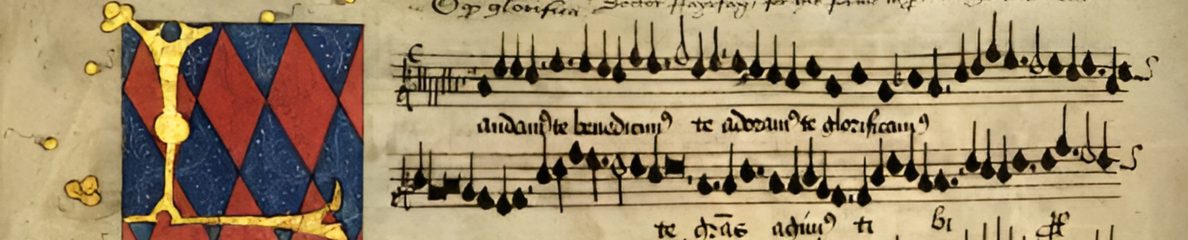
Peter conducted us through the piece with only occasional halts to get us back on track, or to highlight a particularly interesting point. The phrase Gaudeamus is repeated throughout in the 4th line as an ostinato motif, first of all in long sustained phrases, and then doubling in speed towards the end of the second part to accompany the words Vivat Paulus! Vivat Carolus! Vivat Franciscus! The piece then quietens towards the end to echo the wish for everlasting peace. (If you want to hear this piece with whistles and bells, look out for Jordi Savall’s rendition on YouTube.)
The Jubilate Deo was sufficiently well-known and long-lived for its theme, and the ostinato motif, to be “borrowed” by Victoria nearly 50 years later for his Missa Gaudeamus published in 1576. There seems to have been an assumption that the audiences, whoever they may have been, would have been familiar with the source music and therefore able to identify the original motifs embedded in the polyphony. We sang and played through the first two movements of this wonderful mass, and the 4th line again had the Gaudeamus motif. However, at points, Victoria brings it into the upper voices to emphasise it, thus taking Morales’ theme and bringing it to a new level.
We then took a look at Victoria’s Versa est in luctum, the motet of the Officium defunctorum, or Requiem mass, printed in 1603. In his 2019 book, Owen Rees explored further the idea (first proposed in 2009 by Noel O’Regan) of a possible link between the motet and a rather sombre 5 part madrigal by Marenzio (1553/4-1599) written in 1580, Dolorosi martir. In case you thought (as I did) that madrigals were on the whole light and frothy, with occasional forays into unrequited love and lust, this particular madrigal is anything but. Although Morenzio’s madrigals were often very popular in England, this one doesn’t seem to have been welcomed so warmly, perhaps as a result of the gloomy text which speaks of “harsh shackles, cruel snares…my life is now bitter as wormwood.” But the music itself is divine, as is Victoria’s 6 part motet.
The afternoon session was mostly spent working on Guerrero’s glorious 5 part Ave Virgo sanctissima, printed in 1566, and the later 7 part parody mass of the same name by Géry de Ghersem (c.1574-1630), circulated in 1598. Guerrero truly was a genius, although less has been written about him compared to Morales and Victoria. The top two lines of his motet are written in unison canon throughout, a remarkable feat in its own right, but he also includes his own take on the first four notes of the Salve Regina chant with a semi-tone inflection, which is repeated throughout all parts. There was some discussion about the use of accidentals, actual and ficta, and which was likely to be correct. Peter pointed out that trying out alternative solutions can end up “knitting your own Middle ages”, quoting Thurston Dart’s immortal phrase, which nicely encapsulates the challenges of looking so far back in time.
Géry de Ghersem was a prolific and well-known Franco-Flemish composer active in Spain and in his native Low countries. However, his Missa Ave Virgo sanctissima is his only surviving complete work, and I suppose if you are only to be remembered by one piece, then this would be a good candidate. It is stunningly clever polyphony, taking the canonic writing in Guerrero’s motet and expanding this to cover all voices in varying lengths and intervals. Peter included on his handout his own breakdown of all the canonic elements in the score. Some of the elements can be heard, and some are hidden under changing chords as the canon progresses. In the Benedictus he includes a double canon with 4 voices – I can’t even begin to imagine how one would go about writing something so complex, and one can only lament the loss of all his other works in the Lisbon earthquake and fire of 1755.
We finished the day with a short 5 part motet Ave Regina caelorum by Alonso Lobo (1555-1617), which also used Guerrero’s canonic device for the top two lines. It was a satisfying way to end what was a most enjoyable and instructive day. The great benefit of these workshops is the chance to gain a greater understanding of the context in which this wonderful music was written, not to mention the technicalities and methods employed which too often escape the notice of modern eyes and ears. Our thanks go to Peter for once again helping us to appreciate this wonderful music on a deeper level, which makes the performance of it all the more meaningful and satisfying.
Kirsten Flores
First published in February 2024 Newsletter
