
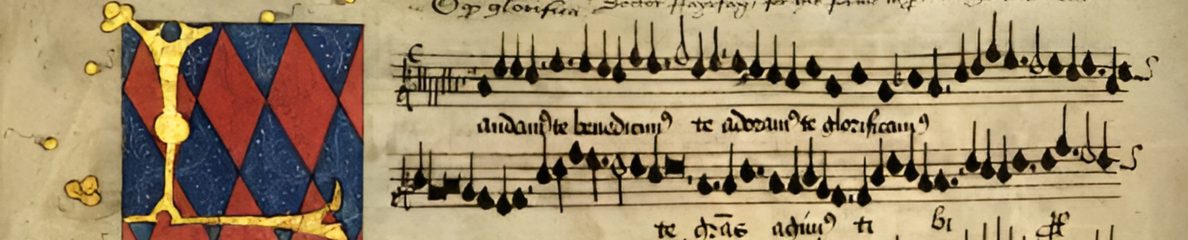

Guillaume de Machaut as shown in a French miniature of the fourteenth century, “An allegorical scene in which Nature offers Machaut three of her children – Sense, Rhetoric, and Music.” For more information, click here.
Machaut & Dunstaple
VOICES
Tutor: John Leigh Nixon
Location: St Peter’s Cathedral Lancaster
Reviewer: Jill Mitchell
Ars Nova with Leigh Nixon
A few years ago our late-lamented Jim Marshall declared, in characteristically oracular manner, that the name of NWEMF should be modified to the ‘more accurate’ NW-FAIRLY-EMF, – an observation that ruffled the odd feather at the time! How delighted he would have been by the prospect of Leigh (John) Nixon’s workshop on November 10th, in St Peter’s Cathedral Lancaster, to be devoted to the fourteenth-century Machaut and the early fifteenth-century Dunstaple!
The event attracted a healthy and well-balanced 40-strong group of male and female singers, few of whom, surprisingly, were from NWEMF; what a missed opportunity! In addition to roughly a third of the participants who had come from Cumbrian choirs, people had travelled considerable distances to be there.
John Nixon has devoted a great part of his professional life to this repertoire, singing for some years with Gothic Voices under Christopher Page before taking on the direction himself. From the days of the Landini Consort he has been a friend and colleague of Peter Syrus, who organised the day with the grace and thoroughness we have come to expect.
All the participants had received the music in advance with the recommendation to do some serious study. From previous experience of John’s workshops, two of MEMF’s in Warwick and one of BMEMF’s last year in Leominster Priory – I knew well the wisdom and value of so doing. From the outset it was clear that all had taken to heart the suggestion to prepare properly and John warmly acknowledged the fact, which had saved him a lot of painstaking time. That said, we all struggled at moments with the complex rhythms, the hocketing, the clear articulation of the text, it being perilously easy to lose the beat – and the place! We spent the morning working in the library of Cathedral House on four pieces by Machaut, three of them in the Courtly Love tradition, wherein the adoring lover abases himself and pleads for a mark of favour from his ever-unobtainable mistress, over whom he rhapsodises with extravagant metaphor. Experiments were made with pitch, modern performances being made difficult by the significantly wider range covered by our S.A.T.B. configuration, so that, depending on the pitch selected, either one or the other end of the spectrum is liable to Discomfort.
First we sang the rondeau Rose, Liz, Printemps, Verdure, with a texted Cantus and the three other lines vocalised to a french ‘u’ ,at a pitch that was a convenient compromise. Then we tried it higher for an all female version and, finally, a lower register with the men on all four lines; it worked perfectly, with predictably interesting variations of sonority and effect.
Next came the one technically simple piece of the day – the delightful unison virelal Douce Dame Jolie with its achingly yearning B section that rose to a real cri de coeur. On two occasions – at this first assay and at the final total run-through – John said we’d just sing the first half, verses 1-5, then called out suddenly to us ‘Verse 6!’ as he clearly couldn’t resist the heartlift of that B section again, where it rises to a new level of pitch and longing.
The third piece, a 3-voiced motet, similarly secular despite its classification, was Fins Cuers Doulz, where the Triplum had a different, complementary text, Dame je suis cilz, and the Tenor, though beginning with the same invocation to the ‘Sweet noble heart’ as the second line, diverges into its own less verbose and quietly reflective text. As in the first piece, all the movement was in the two upper voices, the slow sustained Tenor serving to keep the other parts grounded.
The session ended with the highly ingenious and progressively spirited four-volced Kyrie from Machaut’s Messe de Notre Dame (for Reims, where he served for many years, not Paris). This was, without any doubt, the most difficult piece of’ the day. The first ‘Kyrie’ was disarmingly straightforward. Then came the ‘Christe’ and the final ‘Kyrie’, which called for great accuracy, skill and musicianship: meticulous counting, sure-footed lightness and the internalising of the beat were crucial. Our ‘best’ was not always good enough, but what a tonic the opportunity of this piece was!
We moved into the Cathedral itself after lunch and it was a pleasure to savour this splendid interior and its fine, enabling acoustic. Of the five Dunstaple pieces, four were decidedly sacred, Puisque m’amour alone being of the Courtly Love genre. This was another rondeau with its two contrasting sections. The soulful wistfulness of tile text is offset by the dexterous, flitting movement of the lines, which refuse to wallow, taking amorous disappointment gallantly on the chin! The beautiful alternatim Ave Maris Stella was an old friend: we sang it with Peter in 2003 when the focus was on the profound admiration that Dunstaple evoked in his continental contemporaries. This composer’s Kyrie á 3 was a much easier’ prospect than the Machaut setting but very lovely, the three parts equally poised in complementary agility. The main work of the afternoon, however, was Dunstaple’s tour-de-force which interweaves the two magnificent hymns to the Holy Ghost, Veni Sancte Spiritus and Veni Creator, with a Triplex variation on the ‘Veni Sancte‘ text. Again the 4th line, the Tenor, gets off lightly with its infinitely slowed down Cantus Firmus, which, however, progressively concentrates into diminished note-values. The Tenor’s text is limited to repetitions of lines 2 and 3 of verse 1, whereas the Counter Tenor sings the complete six verses of the ‘Veni Creator’. The whole is an extremely complex and brilliant confection which ideally needed more time than we had to sort out its profounder reaches.
We just had time for Nesciens Mater, a touching and wonder-filled text. Once again we had a slow Tenor foundation-line beneath the fluid Superius with its purposeful, complementary Counter-Tenor. The melody rises in the second half to explore the implications of ‘She alone nourished the King of the angels from her heaven-filled breast’ – a limpid, beautiful setting.
After a welcome tea-break, we took a deep breath and prepared to sing through the day’s menu, hoping fervently to be sufficiently alert. The concentration and focus required were considerable but we acquitted ourselves reasonably and John expressed real appreciation of our efforts. It had been a huge pleasure to sample something of this rewarding repertoire and a privilege to be directed by a tutor of distinction and generosity.
Jill Mitchell
First published in January 2013 Newsletter
