

Josquin & Lassus
VOICES AND INSTRUMENTS
Tutor: David Hatcher
Location: St John’s Parish Centre, Knutsford
Reviewer: Janet Evans
Josquin and Lassus: Praeter rerum seriem
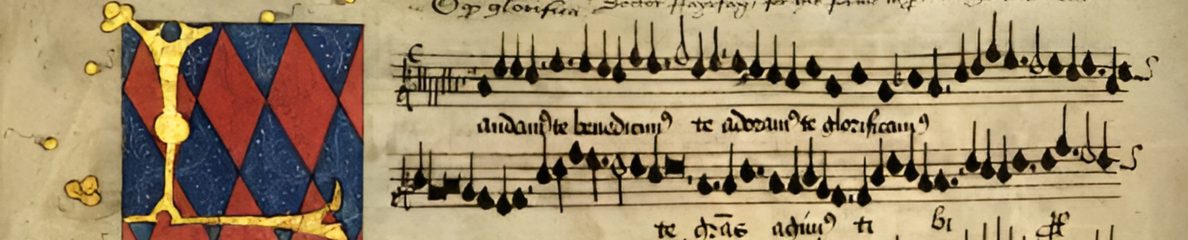
Wonderful music, good teacher and comfortable surroundings: what more could be asked of a workshop? Saturday 13th October saw about 30 of us gathered in St John’s Parish Centre in Knutsford to explore, under the direction of David Hatcher, Josquin’s six-part motet Praeter rerum seriem and the Magnificat from the mass which Lassus composed on the same theme. David explained that in Josquin’s time music had mensuration signs rather than time signatures. The opening of the Discantus part would have looked like this:

After the initial letter, the symbol on the bottom line of the stave indicates middle C (so this clef is called C1, as it has middle C on line 1 of the stave). The circle (a sign of perfection, which meant 3 not 2) and the 2 which follows it are the mensuration symbols and indicate that each longa contains 3 breves, but each breve contains 2 semibreves. The vertical lines which follow are longa rests, each worth 3 breves. These rest symbols clarify the mensuration, as a longa rest that is worth 2 breves would span 2 spaces, not 3. The opening of the Bassus part would have looked like this:

This part has a familiar bass clef sign (F4 – that is F on the 4th line of the stave), followed by the same mensuration symbols as the Discantus and one longa rest.
If you look at the note values of these two parts you will immediately appreciate that the music is very complex, with one part (not always the Discantus) moving in very slow notes while other parts have challenging rhythms. David was using an edition (not his own) in original note values but barred in 3/1, which was rather confusing as each bar contained half of a perfect longa. To make the music fit our voice ranges it had been transposed up a fourth.
The second section of the music was in duple time and David explained the relationship between the two sections. There is evidence which suggests that all the music of Josquin’s time shared a common pulse, possibly the speed at which the Nuremberg Town Hall clock chimed, but the mensuration symbols had to be considered in deciding which note length followed the pulse. It was fortunate that we had the benefit of an expert to guide us through the maze and help us to achieve (eventually) a satisfying performance.
David worked quite a lot on the pronunciation, getting us to sing without the consonants (and then without the vowels) in order to realize that the vowels are more important than the consonants in this type of music.
The Magnificat by Lassus was also in six parts and the theme from Josquin’s music was evident in all the polyphonic sections. There was much shuffling of paper at the end of each polyphonic section, as we retrieved the page with the chant on it, to sing the appropriate section. This was also a very rewarding piece.
At the end of the day we intermingled, ensuring we were not next to someone on our line, to perform both pieces. I for one went home very happy, feeling that it had been a very good day.
Janet Evans
First published in January 2013 Newsletter
