
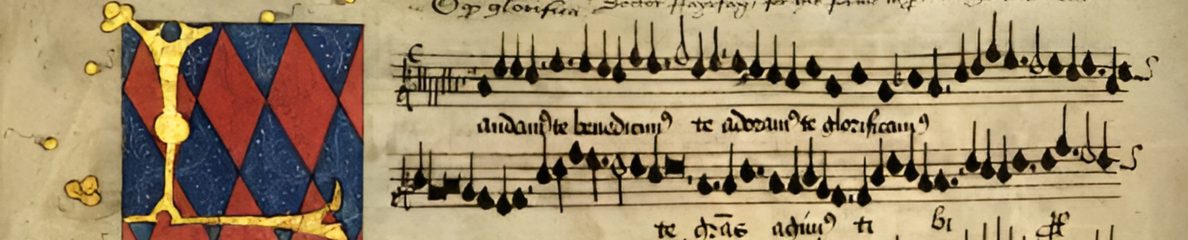

The Sound of Power: Johann Stadlmayr’s Polychoral Music for the Habsburg Courts
VOICES, LOUD WINDS, BASSOONS, SACKBUTS, TROMBONES & STRINGS (A=440)
Tutor: Gawain Glenton
St Mary’s Church Hall, 44 Moss Lane, Sale, M33 6GD
Reviewer: Tom McLean
The appeal of NWEMF workshops has been rising steadily over the past couple of years with increasingly expert and interesting musical directors, and the news that the North West’s very own Gawain Glenton had agreed to run one of them was greeted with great excitement. Many of us have enormously enjoyed Gawain’s performances with groups as diverse as the English cornett and sackbut ensemble and I Fagiolini so expectations for his workshop were set pretty high.
In attendance are 28 voices and 12 instruments with the voices well distributed across the parts and a varied selection of instruments including cornetto, and several trombone, violins, violas and a selection of viols. More on the instruments later!
The subject of this workshop was music from the late 16th /early 17th century court of Innsbruck, a location and repertoire completely new to me, but intriguingly only a few years after the heyday of Byrd, Dowland and all that crowd in England. We also explored some large-scale works by two little-known Italian whose works would have been right at home at Innsbruck. Gawain kicks off the workshop by setting the scene of the emerging Hapsburg dynasty with its regional capital in Innsbruck and its need to project an appropriate sense of wealth and power through artistic patronage.
As the workshop starts it becomes evident that a huge effort of coordination has gone into allocating voices and instruments to the complex range of parts in these pieces. The first is Nos vos me eligistis by Tiburtio Massaino (before 1550-after 1608 – and no, I had never heard of him either) in 15 parts across three choirs, with each choir having a different composition. Someone must have spent hours balancing the voices and instruments across all those parts (and it is going to be different in each piece!) and then making sure we had enough copies of each choir or single parts for the instruments!
And so we dive in with good clear conducting from Gawain and the three choirs joining in and dropping out by turns. This requires ferocious counting in the multiple bars of rest, which most of us singers don’t usually have to contend with but our instrumentalist partners do all the time, so it is very helpful to have a trombone joining in the bass line with us. There then follows an interesting discussion of the 16th century direction that instruments should seek to emulate the sound of voices because the voice is closer to the divine. We return to a second run of the piece, this time Gawain conducts in 2 to a bar and the fluidity of the piece blossoms.
We then move on to Gregorio Zucchini’s Missa sine nomine for 4 choirs, following the more standing SATB composition in each choir. Little is known about this Benedictine monk (c.1540-c.1615) who worked in Italy, and predominantly Rome. To round off the morning we are introduced to Johann Stadlmayr (c.1580-1648) who arrives 30 years later than Massaino and Zucchini. Again we are in 14 parts for the Dies sanctificatus, with one section being entirely instrumental of lower parts (TTBaBB). This provides the opportunity to introduce the amazing bass rackett, a double reed wind instrument whose pipes* are wound inside a small barrel and played by covering the holes like a recorder. The effect is like a curtal but in a very low register and is a wonderful contribution.
* (Actually, not pipes but the bore. Ed)

After the lunch break we restart with the Stadlmayr Dum complerentur, which Gawain describes as “early 17th century rabble rousing”. By this time the counter reformation is in full swing and the catholic Austrians seek a confident statement of the grandeur of their faith. The music is appropriately grand but alleviated from pomposity by repeated switches from 2 to 3 beats in a bar and back, and by dramatic staccato for example on et factus est sweetened with a legato de celo sonus . This also provides an opportunity for Gawain to refine our tuning of the G minor key and he demonstrates the brightness of the E Flat.
Whilst this is right at the edge of my understanding of musical theory, I can indeed hear it when he demonstrates by whistling, and when we sing again the difference is apparent. We end the day with the Stadlmayr Deus qui glorificantes and its name says it all really. A glorious event enabled by a virtuoso tutor with the insight to bring us amateurs to a better understanding and ability in an area of music we hadn’t seen before. Thank you Gawain.
Tom McLean
Published in February 2026 Newsletter
See also Workshop report – 8 November 2025
