

The Music of Juan Gutiérrez de Padilla
VOICES & INSTRUMENTS
Tutor: Clive Walkley
Friends Meeting House, Lancaster
Reviewer: Helen Johnson
On Saturday 9 November, singers and instrumentalists gathered in Lancaster under the expert direction of Clive Walkley to sing music by Juan Gutiérrez de Padilla. Born around 1590 in Málaga in Spain, Padilla received his musical education there before taking up posts in Jerez de la Frontera and Cádiz. In the early 1620s he moved to the Mexican city of Puebla, an important religious centre, where in1629 he became maestro of the cathedral. Some of us admitted we hadn’t previously heard of Padilla, but I think all would now agree that not only is his music beautiful but also a very rewarding challenge to sing and play.
Most of the music we were to perform was for double choir and so the day began by dividing us into choirs and instrumental groups 1 and 2. Instrumental players – recorders, cornetts and bass viol – would be doubling the choral lines, which would prove to be very helpful to the singers!
We began with the 8-part motet Joseph fili David, which Clive had chosen as a fairly gentle introduction to Padilla’s music. This was followed by his mass of the same name based around the themes of the motet. Over the course of the day, we covered a number of lovely pieces, including Deus in adiutorium, Versa est in Luctum and Ave Regina, all of which confirmed Clive’s description of Padilla’s music as “highly expressive” and “plangent”.
This was my first event with NWEMF and I was somewhat surprised that none of the music was sent in advance, even though in this case quite a few of the pieces were available online to download. Having discussed this with a few people, I take the point that if this were done, it would involve assigning lines in advance to individuals, who may then not be flexible on the day if other lines lacked numbers. But this does have an impact on the level of performance achievable.
In each piece, our first sightread through had inevitable highs and lows! This was generally followed by a focus on the especially tricky bits and another sing-through. Clive was unfailingly encouraging and supportive, but I wonder, even given the obviously high level of participants’ sightreading skills, how many of us were able to raise our eyes from the music other than at cadences. I can see that, if music is not to be sent out in advance, a tutor has a decision to make as to whether participants will be offered a wide range of pieces for an initial go, or a small number of pieces more thoroughly rehearsed. I think I might myself prefer the latter, perhaps with an end-of-the-day ‘performance’, although as a sightreading workout this was second to none!
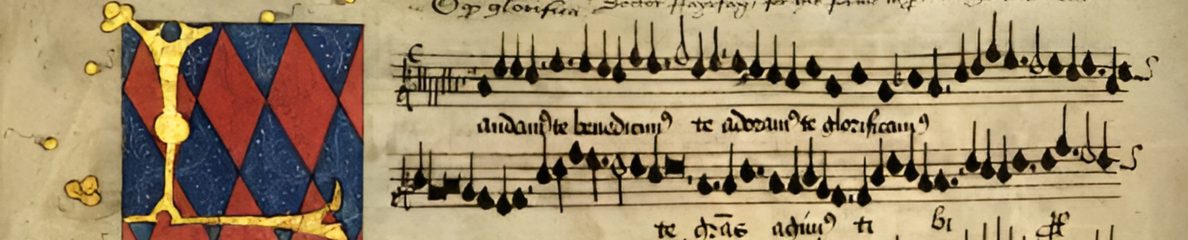
What we certainly did get was a real appreciation of Padilla’s masterful harmonic and rhythmic complexities. Clive also found time to remind us of general principles of early music performance, such as the need to ignore our modern bar lines, often in conflict with meaningful word stress. In addition, he gave us a ten-minute tutorial on how to read our lines from an original facsimile score.
As a newcomer, I very much appreciated the friendliness I encountered from seasoned participants, and the afternoon tea break was further enhanced by Rosy’s excellent lemon drizzle cake.
Thanks to Clive for what was a great day of good-humoured and purposeful collaboration and also lovely music-making that sometimes even verged on truly polished! Clive suggested this might be his last event for NWEMF. If so, on the basis of this one, he will be truly missed. I hope the day was as enjoyable for him as it was for us.
Helen Johnson
First published in February 2025 Newsletter
