

Portrait of Jacob Obrecht, Flemish composer (1458-1505) by Quentin Matsys
Exaudi Nos – the masses and motets of Jacob Obrecht (1457/8-1505)
VOICES
Tutor: Peter Syrus
Location: St. Mary’s Parish church, Cilcain
Reviewer: Hugh Cherry
This was perhaps one of the more specialist workshops of the year. ‘Early Music’ is quite a minority interest even in the world of classical European music, and is a general term – really just saying that the music is composed before a particular date. But which date? For many people who would agree they enjoy music in this category they will be thinking of the 16th century – the century where the renaissance polyphonic style reached its peak in the hands of composers like Byrd, Victoria and Palestrina. Others may be thinking of Monteverdi and Purcell, taking their interest into the 17th century and still others might include J S Bach – extending their interest still further towards the current time. Relatively few will extend their interest further back, even though we have much music (mostly chant) from around 1000 AD and the development of musical notation to preserve and record dates from the next couple of centuries, so there is a lot of music not commonly heard, even by confessed ‘Early Music’ devotees.
Jacob Obrecht takes us back just one step from the 16th century into the previous hundred years, where the foundations of the music of Byrd, Victoria and Purcell were being laid. He was almost an exact contemporary of Josquin des Pres, generally regarded as the great transitional figure into the late renaissance style. However, he had the misfortune to take over Josquin’s post as musician to Duke Hercules I of Ferrara just when the plague was spreading in Northern Italy, so while Josquin had fled to his home land in Northern Europe, Obrecht caught the plague and died less than a year after he arrived in Ferrara in 1504. This workshop looked at 6 compositions by Obrecht, these covering a range of styles, and showed how different European music was a hundred years before Byrd and others.
Our first composition was ‘Parce Domine’, (Spare your people O Lord), which was originally in only three parts, but had had a fourth part added at some point. This does not feel dramatically different from much 16th century music except feeling more austerely modal than the high renaissance style. The final chord (in the three part version) is simply three As each separated by an octave from the next – very plain. The extra part added later (possibly by Obrecht himself) starts by ‘modernising’, adding in the minor third, but abandons that idea by then jumping up to the fifth, converting the chord to just three key notes and the fifth – an ending typical of earlier works, but still quite bleak as it omits the third.
Then we looked at a few movements from two of his masses, of which there are more than 30 surviving. First ‘Missa Petrus Apostolus’ and then ‘Missa Salve Diva Parens’. For the first we just looked at the Kyrie and Agnus Dei, for the second, just the Sanctus and Hosanna. The first introduced us to one of his favourite techniques – complex overlapping and conflicting rhythms. Peter pointed out the music of this period contains far more complex rhythms than any of the later High Renaissance polyphony. Many of the bars illustrated the classic of 2 versus 3 (6/8 versus 3/4), but he is quite happy to simultaneously have another part moving off-beat against both those schemes. He leavens this with the simple technique of two parts travelling in parallel third, sixths or tenths. So you might find yourself to be singing with great concentration against all the other parts, only to find one of them changes sides as it were and gives you relief by joining you rhythmically and just a third or sixth apart (but only for a short me). The effect is tremendous life and interest.
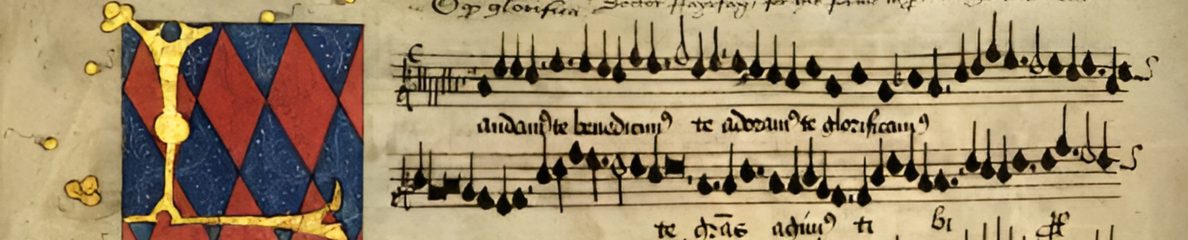
The second mass mentioned above was one of his most popular, and illustrates this approach to an extreme degree. Here is a snippet from the first part of the Sanctus in that mass that illustrates the complexity involved. Try singing the tenor line against the other parts (assuming they are right!).

Following that mass we did battle with one of his most complex compositions, the motet ‘Factor Orbis’ (Maker of the world) where, with the added resources given by five parts, he produces the following few bars. Here the tenors have a rest from complex rhythms.

The important point is that this complexity does work, it has a wonderful effect of energetic activity obeying very strict rules that balance the first impression of chaos.
The final compositions studied were the 4 part ‘Ave Regina Coelorum’, and the 6 part ‘Salve Regina’. These mostly resisted the fascination Obrecht had with cross-rhythms and showed instead that he was very skilled at complex polyphony of great beauty. The ‘Ave Regina coelorum’ was contrasted with a 3 part version of the same text by the English composer Walter Frye from the same period. This felt much warmer than Obrecht’s versions because of the use of major thirds – a typical device popularised by English composers of the time, such as John Dunstable. This permeated the renaissance polyphonic style and is one reason why the late renaissance polyphony somehow sounds more familiar to our ears that the music of Obrecht and his contemporaries.
One of the problems Peter had with all this music was finding compositions where the ranges of the various parts matched his likely forces. On the day we had 6 basses, 2 tenors, 3 altos and 5 sopranos. This is a rather extreme example of a typical profile for these workshops, and was anticipated by Peter in selecting the music – only one piece had two tenor parts. Two of the basses were co-opted to become tenors for the day but the inner parts were still under-represented. This is common in music of the period which tends to cover the ranges of ATB or SAT rather than the full SATB common in modern choirs. You can of course transpose the music but you tend to end up with the sopranos having to grovel or the basses having to scream. There is a NWEMF workshop in September that is specifically only for women singers so it won’t have this problem, but do we have enough men to make a male workshop viable?
All in all this was a lovely look at some infrequently performed music. Many thanks to Peter for all his work, and patience when the ‘interesting’ rhythms perhaps lacked the precision that they needed for best effect.
Hugh Cherry
First published in September 2022 Newsletter
