

Detail of King David from the West Window in the church of Our Lady and St Joseph, Alcester
Praise the Lord! Psalm settings (Lassus, de Monte, Palestrina, Asola)
VOICES & INSTRUMENTS
Tutor: John Bryan
Location: Didsbury Baptist Church
Reviewer: Rhoda Bramhall
Praise The Lord! Renaissance settings of the psalms of King David
So glad I braved the vagaries of trains and trams to arrive at Didsbury Baptist church in time for the start of this workshop. This venue is exactly opposite the metro stop at Didsbury Village, and a well-appointed, light and sympathetic space for music.
We were blessed with several excellent viol players, and a variety of accomplished wind instruments.
John Bryan, of course, was inspirational and enriched the whole workshop from his deep store of knowledge on composers; and with his drive to complete, and polish, the selected items. First off was a two-choir setting of Psalm 98 Cantate Domino by Felis Stefano (1550 – 1603). Born in Bari, Italy, and a contemporary of Phillipe de Monte; operating latterly in Prague and producing “motets, masses and madrigals”. Then Psalm 118 Laudate Dominum Omnes Gentes by Andrea Gabrieli (1532-1585): one time organist at St.Marco Venezia and companion to Lassus when in Bavaria; at one stage “giging” around Prague (Busking ??). In this piece we see him flexing his favourite intervals, namely 3rds, 4ths and minor 3rds, but we seemed to cope!
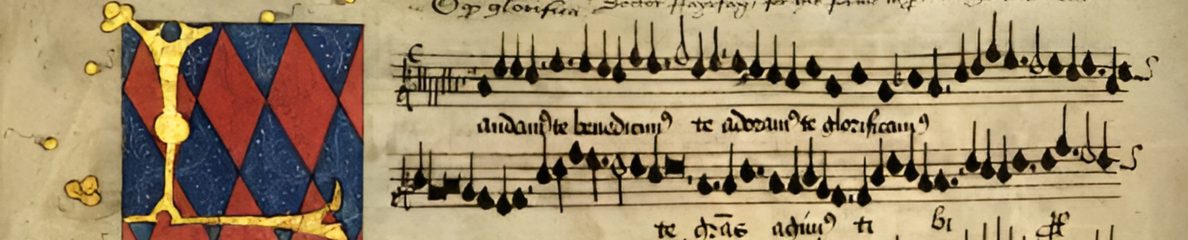
Next up was Laudent Deum – Orlando Lassus (1532-1594). This text from Psalm 150 speaks of praising God on various instruments, both loud and lyrical, including the human voice. It was reproduced in part, with the music, for an engraving used as the cover of a part book, presented to the Bavarian court in 1568. We were treated to enlarged copies of these fragments of facsimile music, and challenged to sing from them without cheating by looking at our 21st century scores. There was also the fun of silencing all the instruments except the one named as it arose; allowing each in turn a tiny solo spot!
After all this levity, we came down to earth with a six-part motet of Lassus In hora Ultima from a posthumous anthology of his, published in 1604, which told us that at the last hour all this hilarity will cease again, naming each instrument in its demise!
Then back to the Psalms, with 148 Laudate Dominum by Giovanni Matteo Asola (1532-1609); a contemporary of Andrea Gabrieli and maestro Di Capella in Verona, while chaplain to the Venetian court. He produced numerous books of “motets, masses and madrigals” and considered Palestrina to be “The King of Music”. Next a simple read through of another Psalm 148 from Phillipe De Monte, published in 1573.
And finally to a twelve part motet by The King of Music himself Palestrina: Laudate Dominum In Tympanis. We enjoyed being three choirs, each voice section very small (e.g. one tenor / one bass). Glorious!
Sorry for the lack of learned musical comments etc. but the plain fact is, I thoroughly enjoyed every minute and went back to Wales, with the football crowds, well pleased and content. Thank you all who gathered.
Rhoda Bramhall
First published in November 2019 Newsletter
