
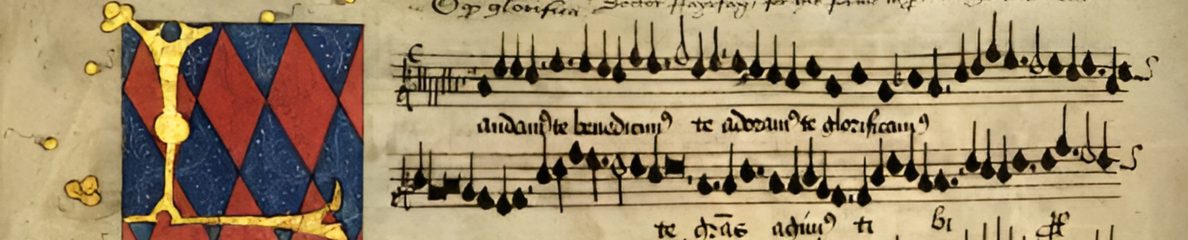

Franciscan, from “Friboug” (Freiburg) Germany, c. 1300
Puer Natus in Bethlehem
VOICES & INSTRUMENTS
Tutor: Ali Kinder
Location: Holy Ascension Church, Upton-by-Chester
Reviewer: David Parry
With a slight nip in the damp November air and Christmas markets in full swing, the Yuletide music season opened for me with the last NWEMF workshop of 2018 at Upton-by-Chester’s parish church. Around 35 singers and instrumentalists joined the event, providing a flexible ensemble of voices, sackbuts, viols, recorders and curtals. This enabled a range of musical colours to be drawn from the sixteenth and seventeenth century Nativity repertoire selected by tutor and viol player, Alison Kinder, making a return visit.
The nineteenth century red sandstone church provided a comfortable performance space and acoustic for the music, historically enhancing the seasonal atmosphere, especially as evening descended. With the range of instruments available, Alison took the concept of “workshop” literally with a degree of experimentation in developing distinctive colours between verses of the works, necessitating some entertaining logistics between voice and instrument sections in re-positioning for each piece.
The session opened with a six-part setting of the Advent text Rorate Coeli by Jacob Handl (1550-91), a Slovenian composer with Venetian influences, previously met as Jacobus Gallus at the 5th March 2016 workshop. Handl makes extensive use of descending scales in all parts to illustrate the sense of “drop down dew ye heavens above”, while reversing the technique to highlight “be the earth opened”.
Acclimatised for the event to come, we crossed the Alps to celebrate the angels’ announcement in the form of Martin Luther’s 1534 hymn Vom Himmel Hoch, set to music by many German composers since. Alison had chosen four versions giving us five verses to perform, the composers being: Michael Praetorius (1571-1621); Johann Hermann Schein (1586-1630); Georgius Förster (1510-1568); Johann Eccard (1553-1611). Drawing on these differing arrangements, Alison directed the ensemble through various combinations of voice and instrument to produce contextually appropriate settings for each verse. What a splendid concert item this would make!
After lunch, we returned to Venice for two items by Giovanni Gabrieli (c1554-1612) celebrating the visit of the shepherds, Angelus ad Pastores (a 12), and the Great Mystery of Christ’s birth, O Magnum Mysterium (a 8). These polychoral compositions each required some spatial re-arrangements, the first providing two instrumental and vocal “choirs” and the second separating voices from instruments, both allowing the strong sackbut section to give the pieces the Gabrieli trade-mark brass sound.
For our concluding piece, we returned to Michael Praetorius for the title piece, Puer Natus in Bethlehem, perhaps the best-known item in the programme. Reverting to a single choir, Alison accented the chorale’s vocal build-up through augmentation by selected instrument groups, culminating in a tutti verse, tinselated with sopranino recorders. This item deployed the strong instrumental representation effectively. I counted 13 players for this one, though I suspect with a number of singer-instrumentalists present, this may have been exceeded on one or two others.
Alison’s enthusiasm for the event was infectious throughout and, although this was not officially a NWEMF Christmas party, musically at least, that’s how I will remember it!
David Parry

First published in February 2019 Newsletter
