
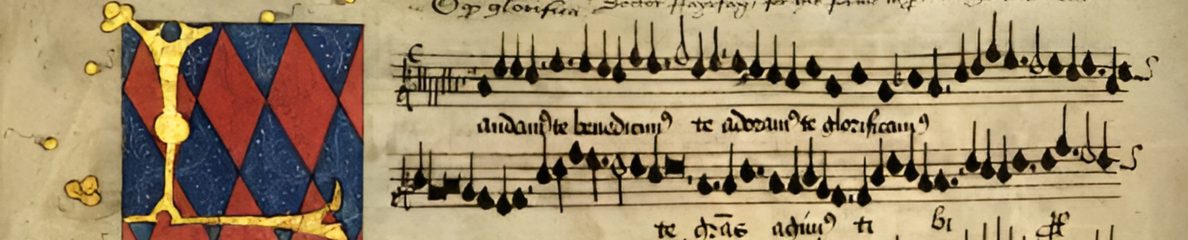

Polyphonic mass by Rogier in Museo Parroquial, Pastrana (photo by PMRMaeyaert – Own work, CC BY-SA 4.0)
Philippe Rogier
VOICES
Tutor: Sally Dunkley
Didsbury Baptist Church, Manchester
Rogier, Sally Dunkley, Didsbury Baptist Church, 16th September
An early music forum workshop should bring together experienced performers, directors and leaders, score-scholars, and aficionados of well-travelled and less-travelled paths. NWEMF on 16th September included all these overlapping categories, but director Sally Dunkley ticked all the boxes. She led the session with charm and authority gained from her performing and recording career in The Sixteen, the Tallis Scholars and Magnificat, and shared her knowledge and insights lightly and assuredly.
Her programme centred on the Franco-Flemish composer Philippe Rogier (1561-1596) who made his regrettably short career in the Spain of Philip II. His music was framed in the context of his Flemish predecessors Gombert (b 1495) and Clemens Non Papa (b 1510), as well as the Spanish tradition of Guerrero (b 1527/8). Clemens’ setting of the Song of Songs motet Ego flos campi and Guerrero’s equally well-known Ave virgo sanctissima set the scene for Rogier’s 5-part Cantantibus Organis and 6-part Laboravi in gemitu meo. Our journey then moved from Gombert’s wonderfully complex motet Ego sum qui sum to Rogier’s parody mass based on it, from which we sang the Gloria and Sanctus. This was music of the highest invention, rooted in the renaissance tradition, but pointing towards the next century.
Many of Rogier’s scores were destroyed in the 1755 Lisbon earthquake. Sally Dunkley’s extensive work on the surviving documents has been a key step in restoring awareness of this remarkable innovator. We read from her user-friendly scores and enjoyed her lightly offered insights into the dilemmas in interpreting and adapting the vocal range for contemporary performances, and judgements about ficta. She invited us to focus on Rogier’s melodic sequences and harmonic invention including “key changes” (avant la lettre!). Her plea for more performances of Rogier’s music fell on convinced and appreciative ears.
The meeting had started with Sally’s apology for bringing too much music, some of which might have to receive minimal attention. However, it became clear early in the proceedings that the NWEMF members did not lack the skill nor energy to address all the delights on offer. A well-balanced choir (11: 8: 6: 7) quickly adapted to Didsbury Baptist Church, and we were encouraged to move between singing in choral blocks to random positions, in order to enhance our enjoyment and involvement in the threads of polyphony; this was maintained through most of the final run of the programme.
It was, in short, an incomparable musical journey, and a great day out!
Roger Williams
