

Machaut et le messager de sa dame
Explore polyphony from 13th & 14th century France
VOICES & INSTRUMENTS
Tutor: Lizzie Gutteridge
Location: Morley Green Club, Wilmslow
Reviewers: Ruth Stock & Hugh Cherry
Machaut, Lizzie Gutteridge, Morley Green, May 6th
An Overview
A relatively small group of singers and instrumentalists enjoyed meeting the knowledgeable and engaging Lizzie Gutteridge who led us in an exploration of some works by Guillaume de Machaut. These reflected his varied career as poet and composer of both sacred and secular work. These were highly influential in France and beyond –Chaucer drew on his lyrics for his “Booke of the Duchesse”.
We started with the single line of melody in the lai “Dames, se vous m’estes lonteinne” a love song which plays with the idea of the distant love brought near by memory, with the refrain “How can I stay far from you”. In this way we made the acquaintance of Machaut’s agile and tuneful style, while also getting to grips with fourteenth century French.
We then explored the unfamiliar harmonic world of Machaut’s polyphony in his Messe de Nostre Dame for four voices, beginning with the Kyrie (or Kyries since there were three, and one Christe eleison). This presumably dates from Machaut’s time as canon of Reims Cathedral (he took Holy Orders in the 1320’s) and is considered to be the first polyphonic mass composed by one person, though possibly not all sections at the same time. The upper and lower voices twine around one another, the upper with repeated overlapping rhythmic patterns and lots of syncopation. The lower voices again overlap but are much more sustained, closely (but not entirely) echoing the related plainchant. We later tackled the Agnus Dei and Ita Missa Est in a similar style, though a different mode.
The remainder of the workshop drew on Machaut’s secular work which he composed in the courtly love conventions of the trouvères. The three part virelais stretched our sense of pitch in places, and the overlapping lines with different words needed lots of concentration. The two top lines are also not far apart in pitch, and for sopranos certainly needed some repositioning of the voice!
It was a most enjoyable day and a great introduction to a composer who was, according to Daniel Leech-Wilkinson, “the last great poet who was also a composer”. His works continued to influence poetry and music into the fifteenth century – apparently Machaut’s works make up the bulk of the manuscripts preserved from the fourteenth century. Workshops on medieval music seem to be a minority taste but are well worth the time. Guillaume de Machaut was honoured and respected by both the church and his royal patrons in his day and his legacy laid some of the groundwork for the later polyphony which we enjoy singing and playing today.
Ruth Stock
Part II
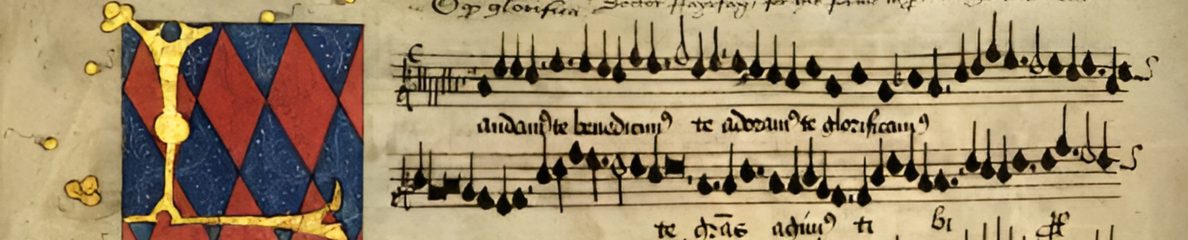
I missed the morning session of this workshop, so am just commenting on the afternoon, when we looked at ”When Adam delved” from a Montserrat MS, “In speculum breve” from the Bamberg MS, the Agnus Dei I,II,II from Machaut’s Mass, “Entre Jehan” and a Hocket from the Montpellier MS, finishing with two Virelais by Machaut, “Douce dame jolie” and “Dames, se vous m’estes lonteinne”. In writing this report, I thought it would be good to see some of the original manuscripts, so below there are pictures of some of these pieces in the original notation. We actually sang from modern editions.
“When Adam delved” was an arrangement by Lizzie of an anonymous tune that appeared in the Libre Vermelle de Montserrat. This collection was prepared around 1400, and was rebound in the 19th century in a red binding. Its purpose was expressed by the compiler:
“Because the pilgrims wish to sing and dance while they keep their watch at night in the church of the Blessed Mary of Montserrat, and also in the light of day; and in the church no songs should be sung unless they are chaste and pious, for that reason these songs that appear here have been written. And these should be used modestly, and take care that no one who keeps watch in prayer and contemplation is disturbed.”
So perhaps they had problems with riotous pilgrims! The original title of this piece is “Stella Splendens” (Splendid Star). Here is the beginning in the manuscript:

The musical form is the Virelai, which is a very common verse form of the time involving repeating music with different words, but the same rhymes. Lizzie had set English words telling the story of the peasant’s revolt of 1381 (the same period as the music) and in particular around the preaching of John Ball who originated the phrase “When Adam delved and Eve span, who was then the gentleman?”. This gave a rousing popular song which we rendered with perhaps more enthusiasm than accuracy, accompanied/assisted by Lizzie on the fiddle.
The second piece – “In speculum breve” was from the Bamberg MS which is one of two of the great collections of medieval music that we used in this workshop, the other being the Montpellier MS. Here:

is a fragment of the Bamberg Codex, containing the start of this piece. As can be seen, this is untexted, so we experimented with various vocalisations, and also with pure instrumental performance with 3 recorders and 2 recorders with fiddle. In one interesting rendition we tried different vowels in the three parts, which clarified the structure. As Lizzie pointed out, we have very little information on how these pieces were performed, so our experiments were quite valid.
We then sang the Agnus Dei I, II and III from the Messe de Notre Dame by Machaut, and “Ite missa est” from the same Mass. Most of this Mass was sung in the morning session, so I shan’t say any more about it here.
Our next two pieces were from the Montpellier MS – here is the start of the first piece “Entre Jehan” in that manuscript (on the left hand side of this clip).

You can see the second part on the right hand side, with a different text “Nus hom ne puet desiervir”. The third part for that piece is at the bottom right with just the words “Chose Tassin” and no more words (Lizzie suggested this bottom line was actually a dance tune and the two upper parts with different words were written as a kind of joint counterpoint above it). Performance of this raised the common issue among music of this period of the very restricted range – in the original the highest note was the G above middle C and the lowest the A at the bottom of the bass clef. So this was all singable by men’s voices (which is probably the reason for the restricted range) but, of course, if transposed, equally all singable by women’s voices. In order that we could all sing it together we transposed it down a fourth, where it was still fine for the men’s voices, but also, put up an octave, equally fine for women. We then sang it with men and women in parallel octaves, or alternating with just men or women. To me the versions with just men or women sounded better than the joint rendition, I think because the parallel octave singing seemed a bit odd with rapidly moving counter rhythms.
The second piece from the Montpellier MS was a hocket in three parts. The technique of hocketing is dividing one melodic line between two (or more) performers so that they alternate either notes or phrases. It is still used today in modern contemporary music, popular music, Indonesian Gamelan music, Andean panpipe music, and handbell music among many examples. In this piece, as was typical of the time, one voice would sing a quaver on the beat and the other part would follow with the next quaver immediately, then ‘passing control’ back to the first part, often with an intervening quaver rest as the music was in groups of 3 quavers. These two parts were supported by a slower continuous lower part to hold everything together. It was pointed out that the lower part, despite its crucial role as a rhythmic anchor, should still be sung smoothly to provide ontinuity, but retaining a very precise rhythm. This was hard to get together, but very exciting when it worked.
To finish with we returned to Machaut’s Virelais with one of his most famous, “Douce Dame Jolie” and then “Dames, se vous m’estes lonteinne” which Lizzie accompanied on her medieval bagpipes, whose drone provided a welcome stability to our sometimes variable pitching.
A fascinating day (I wish I had been to the morning) which highlighted how much creativity one can apply to this music, as the manuscripts can only tell you so much. We were working from modern editions which saved us having to interpret the manuscripts, but even then there was plenty of scope for discussion of performance. What impressed was the energy and rhythmic excitement of the music, and we were all very grateful for Lizzie’s enthusiastic direction and support using her bagpipes, fiddle and recorders.
Hugh Cherry
First published in June 2017 Newsletter
