

JUAN ESQUIVEL: Music from a Golden Age
VOICES & INSTRUMENTS
Tutor: Clive Walkley
Location: St Mark’s Church, Natland, near Kendal, Cumbria
Reviewer: Hugh Cherry
Juan Esquivel in the Lake District
On Saturday 9th April 2011 a group of singers and instrumentalists gathered in the parish church at Natland on the edge of the Lake District to study the music of Juan Esquivel (c.1560-after 1623) under the direction of Clive Walkely, whose recent book on Esquivel is the first full study of his life and work. Esquivel is not a familiar name even to those that love the music of Palestrina, Victoria and William Byrd – he spent his life as choir master in Ciudad Rodrigo in provincial Spain and his music comes down to us largely as a result of some fortunate patronage that enabled the publication of three collections of his works. We sang and played some of his shorter works and much of one of his full masses.
Having warmed up a little with a simple Alleluia, we started with a 5 part Ave Maria with voices and instruments (Recorders, sackbuts, bass viol and archlute). This seems to have been based on one of Guerrero’s pieces, the motet Ave Virgo Sanctissima. Like that piece it has a canon at the unison between the two soprano parts, and seems to use some of the same material. Esquivel’s piece is simpler but he is more profligate with ideas (or less willing to develop them), no sooner is one idea introduced than it is discarded and a new idea appears. Next we sang a simple triple time plainsong hymn Fortem virili pectore, which celebrates “Everyday women”. This is the only original hymn Clive found in his researches on Esquivel – it occurs buried in 24 books dating from the 18th century. After some work he was able to persuade us that it should really go quite fast, but perhaps it was still a bit early in the day for that. The final piece before the main work of the day was an In paradisum in 6 parts. This was written for a funeral procession and the second line had an ostinato repetition of the phrase “Requiescat in pace” (Rest in peace). This gave rise to a question about why the upper parts split, not the lower ones, and this is likely to have been due to the singers available. Ciudad Rodrigo was not a wealthy institution and much of Esquivel’s writing is in 4 or 5 parts rather than more, reflecting the forces available. Clive pointed out that the 25 or so of us would have been considerably more than Esquivel could have had, although possibly his singers were better trained (see some of the remarks below)!
The main work of the day was the Missa ut re mi fa sol la, transposed down a 4th to spare the sopranos high Gs. This had the unfortunate effect of the altos in particular exploring their lower (perhaps non-existent) registers, but was perhaps the best compromise. There are many hexachord masses, and the discussion on this prompted a brief demonstration by Clive of Guido d’Arezzo’s hand symbols for teaching singing using the hexachord, used for many hundred’s of years after his death in the 11th century. Returning to the mass itself, Clive pointed out that Esquivel’s approach working the hexachord into his material seemed less structural than many other composers such as Palestrina. Although the hexachord, and fragments of it, appeared throughout Esquivel’s mass it only occasionally seems to form part of the structural fabric of the composition. To follow up this idea, we were able briefly to compare part of that mass with a similar section from Palestrina’s mass on the same subject (the Hexachord). This was quite revealing, and made I think many of us feel that it is in the larger works that composers reveal their full abilities. The shorter pieces we sang were most effective and well crafted – it was only in the longer work, and under the rather harsh test of direct comparison with one of the greatest masters of this style that Esquivel’s music seemed somehow less adventurous and imaginatively constructed. However it is still of a quality that nearly 400 years after his death we are gathering together to sing and play it. I hope he would be pleased.
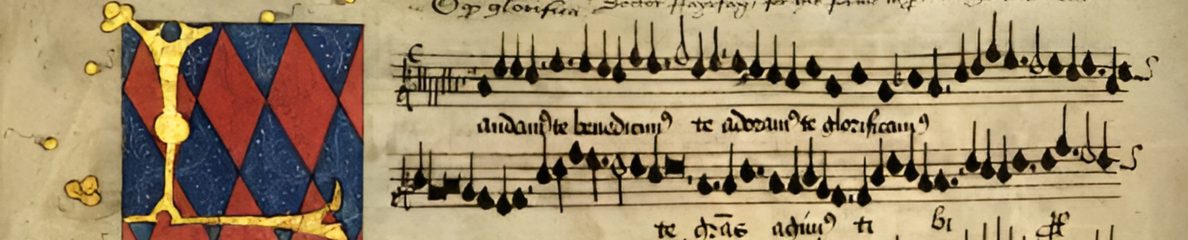
As a diversion during the mass we attempted a short section of facsimile reading of one of Esquivel’s short pieces Beata Dei genitrix Maria, which indulged the sopranos by giving them a modern treble G clef, but left the rest of us battling not only with the unfamiliar note values and rests, but with three different C clefs, depending on the parts. This had the useful effect of relaxing us when we returned to the modern edition of the hexachord mass for the Agnus Dei.
In all it was a fascinating exploration of one of the lesser known composers of Renaissance Spain, and we were all grateful for Clive’s patience and skill at guiding us through it. Perhaps the best feel for the day comes from a few of his remarks as the day progressed.
| Fortem virilis | “Celebrating everyday women” |
| In paradisum | “Lovely – a good send off for somebody” |
| Missa Ut Re Mi Fa Sol La | “Live dangerously” |
| re. Altos | “Brilliant – given another 6 years you’d get it right” |
| re. All | “If you were a singer in the sixteenth century and sang it like that then you would be in trouble” |
| Re. Credos (Stravinsky) | “Credos are difficult to sing – so many things in which to believe” |
| Facsimile | “Easier than Sudoku” |
| Singing | “Think where the phrases are going” |
| “It’s all there in the music” | |
| “Test of a good performing group is if you can sing pianissimo” | |
| “Works much better with voices than on the computer” | |
| Finally, for the Agnus Dei | “Quite nice, that last chord” |
First published in June 2011 Newsletter
Photo of St Mark’s Church in Natland by Alexander P Kapp, CC BY-SA 2.0, https://commons.wikimedia.org/w/index.php?curid=8014037
