

Du Fay (left) beside a portative organ, with Gilles Binchois (right) holding a small harp in a miniature from before 1451 By Master of the Missal of Paul Beye
Music from the early fifteenth-century: a musical moment
VOICES
Tutor: Don Greig
Location: Morley Green Club, Wilmslow
Reviewer: Hugh Cherry
Music from the early 15th century – ‘A Musical Moment’
Eighteen people assembled at the Morley Green Village Hall on Saturday 24th March for this workshop studying vocal music around 1400. This is a hundred years before the familiar Renaissance music of Palestrina and Byrd was ushered in by Josquin Des Pres and others, and the distance in time really showed in the very different style of the music. Don has long experience, having sung in the Tallis Scholars for many years and more recently being a founder member of the Orlando Consort, which specialises in the music of this period.
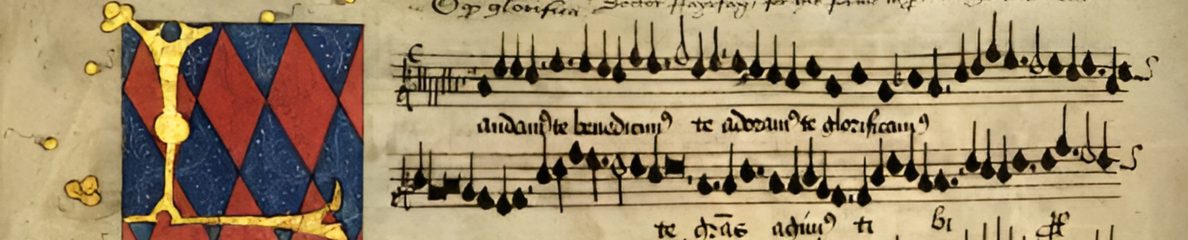
Gregorian chant provided the basis for much western musical development in the 14th and 15th centuries, so we started by singing through a single chant from the original square notation. Once that was reasonably stable we moved on to singing some Fauxbourdon examples. This was one of the first approaches to part writing, a means whereby a group could split into three parts, one above and one below the original chant, and produce a harmonious effect with minimal complexity. This was achieved by the top part singing a fourth above, and the bottom part a third below, tracking the chant (the ‘tenor’ part) as it moved up and down, and singing the same rhythm. For those familiar with musical theory this gives a series of first inversion chords. To start and finish, the bottom part fell a further third to the root, but otherwise stuck to singing a third below the Tenor. Note that the third and fourth refer to the scale in operation, so the thirds could be major or minor; thus if the Tenor was a C the lower part would sing an A (a minor third below), while if it was an E the lower part would be singing C (a major third below). Similarly if the Tenor sang an F the higher note would be a B, giving an augmented fourth. The exact harmony would therefore vary slightly depending on the position of the tenor’s note in the scale. This approach was surprisingly effective – we sang a few examples and the increase in richness from the simple chant was noticeable. Don pointed out that it was clear that early 15C composers were totally familiar with this technique and, even in their more complex pieces, sections of Fauxbourdon frequently appeared.
We next sung ‘Salve sancta parens’ by Binchois (1400-1460). This relied heavily on Fauxbourdon, but moved away from it as the parts had slightly different rhythms. At the ends of phrases there was often what at first sight looked as though it was going to be a conventional cadence with the tenor part rising a semitone to the final note. However the upper part did the same which gave a striking effect quite unlike the conventional modern cadence. We were told it was important to sing the leading notes a bit sharp as at that time thirds were regarded as dissonances, and so the ‘chord’ preceding the final one should be ‘nasty’. The final chord was normally just octaves and fifths, without a third – a very ‘clean’ sound.
This stimulated a discussion on pitching of ensemble singing. Don pointed out that a typical group of singers would always tend to sing in a kind of mean tone temperament where the thirds are flatter than in modern equal temperament and consequently more sweet as they are closer to the ‘perfect’ tuning of a major third with a frequency ratio of 5:4. So it is hard for us to sing very sharp thirds at cadences as is required in this period. This gave rise to a lively discussion about the general issues of temperament and tuning which was swiftly adjourned to avoid occupying the whole workshop. One point that did emerge, however, was that during this period the major third became regarded as a consonance, particularly because of John Dunstable’s music in England, and was then ‘liberated’ to be sung flatter, and more beautifully (at least to our ears). Final cadences were then much more likely to have a third, leaving behind the rather bleak open chords from earlier years.
We moved on to ‘Sanctus incipit’ by Richard Loqueville (probably Dufay’s teacher) to show how the style developed from the simple Fauxbourdon approach. This is a four part piece with very complex rhythms. The basic grouping was in threes, like three in a bar, but often the different parts were clearly singing in 2 in a bar or possibly displaced by half a ‘beat’ to sing across the notional barlines. In some places, one of the parts was further tripletising the quavers, to give, as it were, nine in a bar against normal quavers moving either in 2 or three crotchets in a bar. After some work we were pleased to sing it more or less right, although as Don pointed out, to add to the rhythmic interest, the harmonies were also quite exotic (perhaps not as exotic as our rendition indicated, however).
The final stage of development was exemplified by a Dufay piece ‘Je me complains’. As the original only has one set of words, Don had set two verses of a contemporary poem to this music, a process known in the 15C as producing a ‘contrafactum’. This sounded instantly cleaner and more refined than the Loqueville piece, and finished some of its phrases on a major chord, something Loqueville carefully avoided. With the benefit of hindsight looking from the 21st century, it seemed to us that Dufay had made an enormous step forward in rigour and clarity of composition to move towards what would, 150 years later, be the high Renaissance style of Victoria, Palestrina and Byrd. Of course, were we rooted in the 15th century we might have regarded Dufay’s style as uncomfortably rigid. It is perhaps dangerous to regard musical developments as ‘progress’ in the same way as improvements in technology.
For the rest of the day we looked at other contemporary pieces which illustrated different facets of the style. It became clear that new styles percolate unevenly through the musical establishments, so pieces written at the same time will often use different techniques for all sorts of local reasons. For example, a piece by Franchois, written in the 1420s, ended on a very conventional cadence going from A major into D despite sounding very ‘early’ through most of its length. Another piece, by Billart, written around 1400 had even more complex rhythms than the Locqueville piece sung earlier, but did have something approaching a modern four part texture with two high and two low parts. This was an interesting issue, as some of the pieces had three, possibly complex, parts spanning exactly the same ranges, while some others could be fitted in to the conventional roughly three octave range of SATB. Where we had pieces with all parts at the same pitch Don recommended just singing in octaves, and this seemed to work well.
All in all it was a fascinating day, with a wealth of music that we only started to appreciate properly, but enough to gain some feeling of the enormous change in style in the early years of the 15th century. In particular, as mentioned above, it did seem to represent a change from an austerely medieval sound to a more mellow and harmonious texture, a journey which was perhaps brought to its conclusion in the late Renaissance style. We were all most grateful to Don’s patience with our struggles with the unfamiliar music, and he did succeed in opening a door into one of the most interesting periods of change in Western music.
Hugh Cherry
First published in April 2018 Newsletter
